Introduction At the end of the 2nd World War, much of Europe was. in ruins :there were some eight million foreign displaced persons in Germany, mainly forced laborers and prisoners; including around 400,000 from the concentration capmp system, survivors from a much larger number who had died from starvation, harsh conditions, murder, or being uoworked to death. Over 10 million German-speaking refugees arrived in Germany from other countries in Central and Eastern Europe. Some 9 million Germans were POWs, many of whom were kept as forced laborers for several years to provide restitution to the countries Germany had devastated in the war, and some industrial equipment was removed as reparations.
To begin our tale it seems strange to start at the end think it explains Russian mind set ,
The Ukrainian War of Independence, a period of sustained warlike conflict, lasted from 1917 to 1921 and resulted in the establishment and development of a Ukrainian republic, most of which was later absorbed into the Soviet Union as the Ukrainian Soviet Socialist Republic of 1922–1991.
Ukrainian War of Independence(Part of the Eastern Front of World War I) and the Southern Front of the Russian Civil War
A pro-Tsentralna Rada demonstration in Kiev‘s Sofia Square, 1917.Date8 November 1917 – 17 November 1921
(4 years, 1 week and 2 monthst* Army, resulting in the creation of the Ukrainian SSR, while an independent Poland seizes most of the territory of present-day western Ukrainian or does straggle Transcsrpathia make anyn more p¿mn
M

Also:
- Komancza Republic
(1918–19) - Hutsul Republic
(1919)
 Germany
(1918) Poland
(1920–21) Ukrainian SSR
(1917-18, 1918, 1919-21) Russian SFSR
(1917-21)


Also:
- Odessa SR
(1918) - D-KRSR
(1918) - Taurida SSR
(1918) - Galician SSR
(1920)
 Free Territory
(1918-1920)

Ukrainian State (1918)
South Russia (1918–20)


The war consisted of a series of military conflicts between different governmental, political and military forces.
Belligerents included nationalists, anarchists,[1] Bolsheviks, the forces of Germany and Austria-Hungary, the White Russian Volunteer Army, and Second Polish Republic forces. They struggled for control of Ukraine after the February Revolution (March 1917) in the Russian Empire.
The Allied forces of Romania and France also became involved. The struggle lasted from February 1917 to November 1921 and resulted in the division of Ukraine between the Bolshevik Ukrainian SSR, Poland, Romania, and Czechoslovakia.
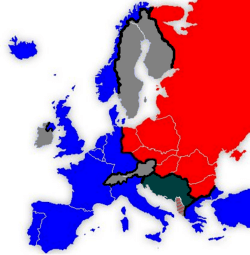
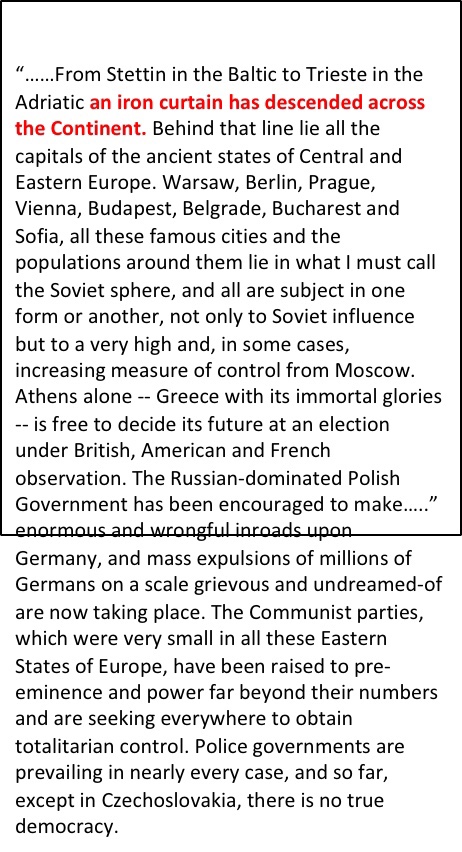
The Iron Curtain is a Western term made famous by Winston Churchill referring to the boundary which symbolically, ideologically, and physically divided Europe into two separate areas from the end of World War II, until the end of the Cold War, roughly 1945 to 1990. After the end of the Cold War and the spheres of influence were determined by the Allied powers at Potsdam and Yalta, the divisions between the wartime allies soon reappeared as the struggle between capitalism and communism heated up. These tensions were felt as, one by one, communist governments were installed in the Eastern European states under the Soviet sphere of influence. The “iron curtain” became the symbol of the division between two competing ideologies and systems as the competition for world dominance of these two systems dominated the last half of the twentieth century. The fall of the Berlin Wall signaled the end of the iron curtain, as communism collapsed and freedom and democracy came to the Eastern bloc. The West finally prevailed, demonstrating that ideals cannot be artificially kept behind walls and boundaries.
This is our twinned Rotary club. The dates tell their story. Formed in the heady rush of the Ukrainian independence movement.
Ultimately crushed by Germans as they swept east, battered again as the now beaten Germans deployed a scorched earth policy. Hot on their heels were the jubilant Red Army come to “liberate” them. After the war was “won” there followed 45 years of increasingly pointless occupation. When the gates were pushed they opened,without from our twinned club on the river uze to Stalingrad is only 1200 miles,about the same as Birstall to Uzhgorod !
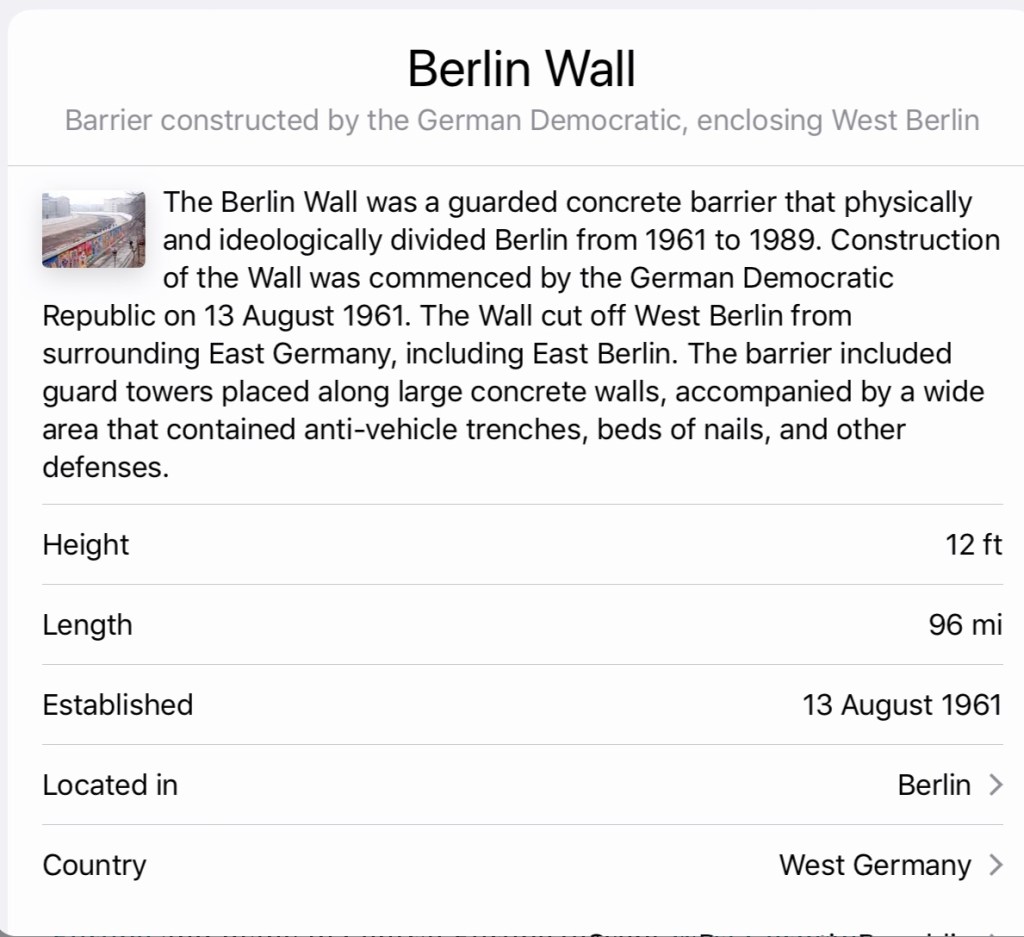
While the Iron Curtain was in place, (4,300 mi) long physical barrier of fences, walls, minefields, and watchtowers that divided the “east” and “west”. The Berlin Wall was also part of this physical barrier.Before the wall was built many of the best brains in East Germany were crossing over to the west.
the countries of Eastern Europe and many in Central Europe (except West Germany, Liechtenstein, Switzerland, and Austria) were under the political influence of the Soviet Union. Indeed the Central European states to the east of the Curtain were frequently regarded as being part of Eastern Europe, rather than Central Europe even though geographically Prague, the capital of the Czech Republic, is considerably further West than Vienna, the capital of Austria. Berlin, the capital of the reunited Germany, is only slightly to the West of Prague.
Many of the states were members of the Soviet Union itself (the Soviet Socialist Republics), while, with two exceptions, the neighboring countries of the Eastern bloc were ruled by pro-Soviet governments, kept in place by the threat of military force. The two exceptions were Socialist Federal Republic of Yugoslavia, which retained its full independence, and Albania, which escaped Soviet influence in the 1960s, and aligned itself with China; both Albania and Yugoslavia were Communist states.
To the east of the Iron Curtain, the states developed their own international economic and military alliances, COMECON (Council for Mutual Economic Assistanc) and the Warsaw Pact. Do counter act tge power of NATO, of which the UK is a leading member.
In the Soviet Union, the speech was seen by Joseph Stalin as reinforcing his view that a future conflict with the West was inevitable. Over the following months, through a mixture of persuasion and purges of those holding contrary views, the Soviet Union did indeed come to see the West as a threat, rather than the ally they had been during World War II. The Cold War had begun in earnest.
OCCUPATION At wars end Germany was divided into 4 sectors everything to the east of River Elbe came under Russian control and to its west was divided between the USA UK & France .Standing armies of occupation , in the minds of the Germans the armjes would remain in Germany to protect it
The Iron Curtain as a physical entity
The Iron Curtain took physical form in the shape of border defenses between the countries of the western and eastern blocs. These were some of the most heavily militarized areas in the world, particularly the so-called “inner German border”—commonly known simply as (die Grenze in German)—between East and West Germany.
The inner German border was marked in rural areas by double fences made of steel mesh (expanded metal) with sharp edges, while near urban areas a high concrete barrier similar to the Berlin Wall was built. The barrier was always a short distance inside East German territory to avoid any intrusion into Western territory. The actual borderline was marked by posts and signs and was overlooked by numerous watchtowers set behind the barrier. In some places, a “death strip” was constructed on the East German side of the barrier, in which unauthorized access would be met with bullets.
The strip of land on the West German side of the barrier—between the actual borderline and the barrier—was readily accessible but only at considerable personal risk, as it was patrolled by both East and West German border guards. Shooting incidents were not uncommon, and a total of 28 East German border guards were killed between 1948–1981 (some may have been victims of “friendly fire” by their own side).
Elsewhere, the border defenses between west and east were much lighter. The border between Hungary and neutral Austria, for instance, was marked by a simple chain link fence which was easily removed when it became the first part of the Iron Curtain to be dismantled in 1989.
P
Background
BERLIN ‘45
• Assaulted
• Occupied
• Divided
• COLD WAR
• Besieged
• The air lift
• Presidential visits
• Wall dismantled
• SOVIET UNION COLLAPSES
• Reunification
• Powerhouse
Berlin 45
 General Snippets